
Checking Criminal History in Pike County
Start a Pike County criminal history search by deciding whether the question concerns a court case, a recent arrest, a police report, state conviction information, or current custody. The Pike County Circuit Clerk links directly to Judici under court code IL075015J for public case inquiry. The sheriff publishes weekly LAWMAN arrest reports and accepts Illinois Freedom of Information Act requests for records it holds. Illinois State Police maintains the separate state repository.
Gather a full legal name, date of birth when lawfully available, spelling variants, an approximate incident or filing date, and the agency involved. A name match alone is weak proof. Compare the case number, age or birth information, charge, court, arresting agency, and final disposition before deciding that two entries concern the same person.
- Search the Pike County Judici court for filed cases and docket outcomes.
- Check the sheriff's official weekly arrest reports when the question concerns a recent booking.
- Request the underlying incident report from the arresting agency, which may be the sheriff, Pittsfield Police, or another agency.
- Compare the court disposition with the arrest or booking entry, since the original allegation may change.
- Use the Circuit Clerk for certified court copies or ISP for the appropriate official state record product.
Pike County's Three Record Systems
Judici, LAWMAN, and ISP answer different questions. Judici is the court index linked by the Circuit Clerk. It can expose case numbers, parties, filing dates, scheduled events, docket entries, dispositions, and financial information, though document images may not be available. LAWMAN is the sheriff's week-based jail output. It can show confinement and release dates, arresting or holding agency, and reported charge text. CHIRP is the authenticated ISP route for conviction information under the Uniform Conviction Information Act.
A careful Pike County criminal record check follows the record from its creator to its final custodian instead of treating one database as a universal certificate.
Illinois Official Background Checks
The Illinois State Police Bureau of Identification keeps the central criminal-history repository. Its Criminal History Information Response Process, or CHIRP, provides the public UCIA conviction-information product through an Illinois Digital ID and ISP user agreement. ISP lists a $10 electronic name inquiry and a $16 paper name inquiry. A CHIRP response is not the same as a person's complete fingerprint-based history.
For review of your own Illinois record, ISP's Access and Review process uses fingerprints captured by a participating law-enforcement or correctional facility or an Illinois-licensed live-scan vendor. ISP does not charge for the personal review or challenge, although the fingerprint capturer may charge. The response includes a challenge form when a record exists. Certified Pike dispositions supporting a correction should come from the Circuit Clerk.
| Electronic name inquiry | $10 ISP charge |
|---|---|
| Paper name inquiry | $16 ISP charge |
| State-only fingerprint inquiry | $15 electronic or $20 paper ISP charge, plus any vendor fee |
| Personal Access and Review | No ISP processing or challenge fee; capture fees may apply |
Pike County Courthouse Record Hub
The Pike County Courthouse at 100 E. Washington Street in Pittsfield concentrates the Circuit Clerk, courtrooms, State's Attorney, and probation functions. The clerk counter is open weekdays from 8:30 a.m. to 4:30 p.m. and can be reached at 217-285-6612. This is the practical fallback when Judici lacks an older entry, a docket does not include the document itself, or a certified copy is needed.
The Circuit Clerk's official page links the public inquiry and payment routes.
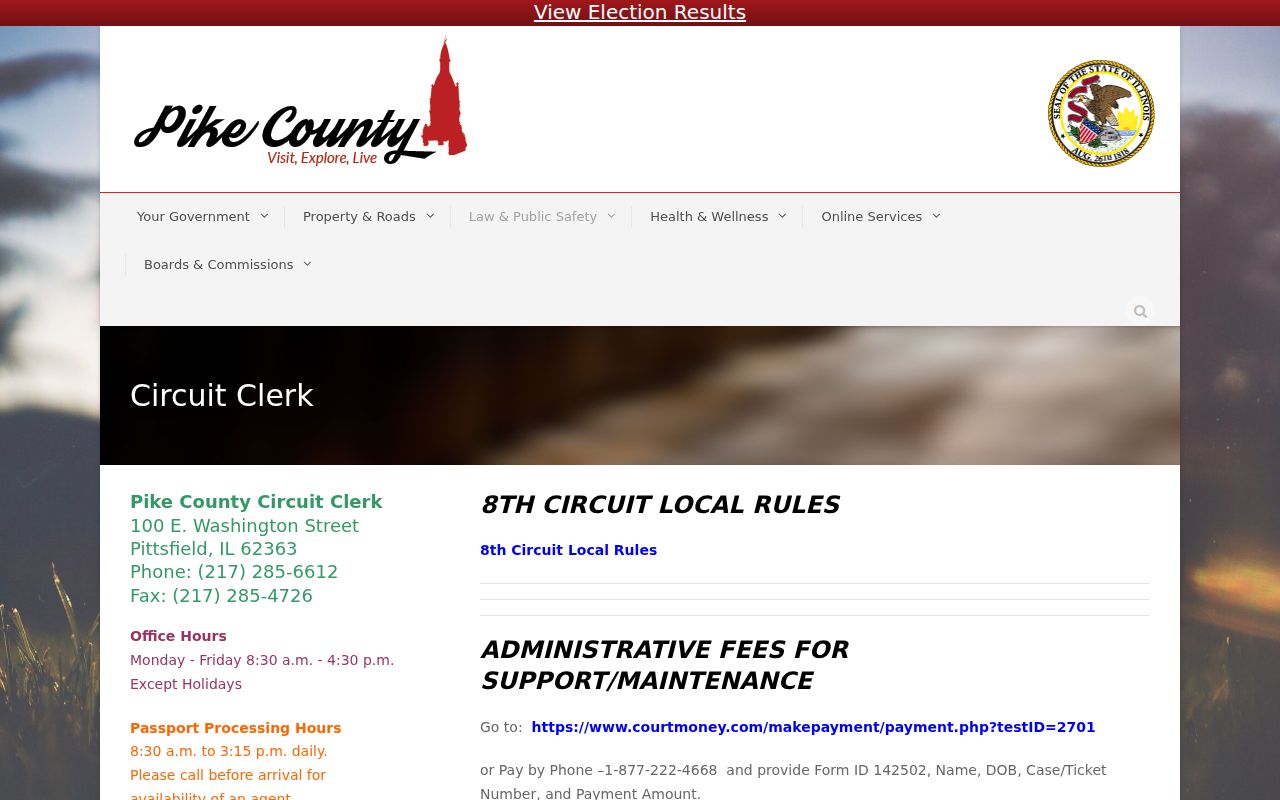
The captured clerk page illustrates why a Pike County court search should begin with the county's own routing page, even though the actual index is hosted by Judici.
Criminal Record Types
Pike County criminal records are created at different steps. An investigating agency writes an incident report. A custodial arrest creates a jail booking. The State's Attorney selects the filed counts, and the Circuit Clerk maintains the docket, orders, disposition, sentence, and financial ledger. ISP receives reportable arrest fingerprints and later dispositions. IDOC creates a state-custody record after a prison transfer, while the ISP registry is a separate statutory notification system.
The custodian matters. Pittsfield Police keeps its investigative reports. Barry contracts with the Pike County Sheriff, so sheriff records are the local report route there. Griggsville police requests begin with the city's FOIA officer. Charged cases from all three cities converge at Pike Circuit Court.
- Incident and arrest reports describe an agency's response and alleged offense.
- Booking records document intake, custody, holds, and release at Pike County Jail.
- Court files track filed charges, hearings, pleas, rulings, outcomes, and sentences.
- Repository records compile reportable Illinois history and public conviction information.
- Supervision and registry records concern probation, parole or MSR, and statutory registration duties.
Pike Sheriff FOIA Channels
The Pike County Sheriff's Department calls its unit Records/FOI/Civil Process. A requester can email the form to abrawdy@pikecountysd.org, fax it to 217-285-4334, or mail or deliver it to 204 E. Adams Street, Pittsfield, IL 62363. General records questions go to 217-285-7000 extension 101. E9-1-1 records use a separate contact, and crash reports route to the Illinois Motorist Report system.
The sheriff's records page sets out those access routes.
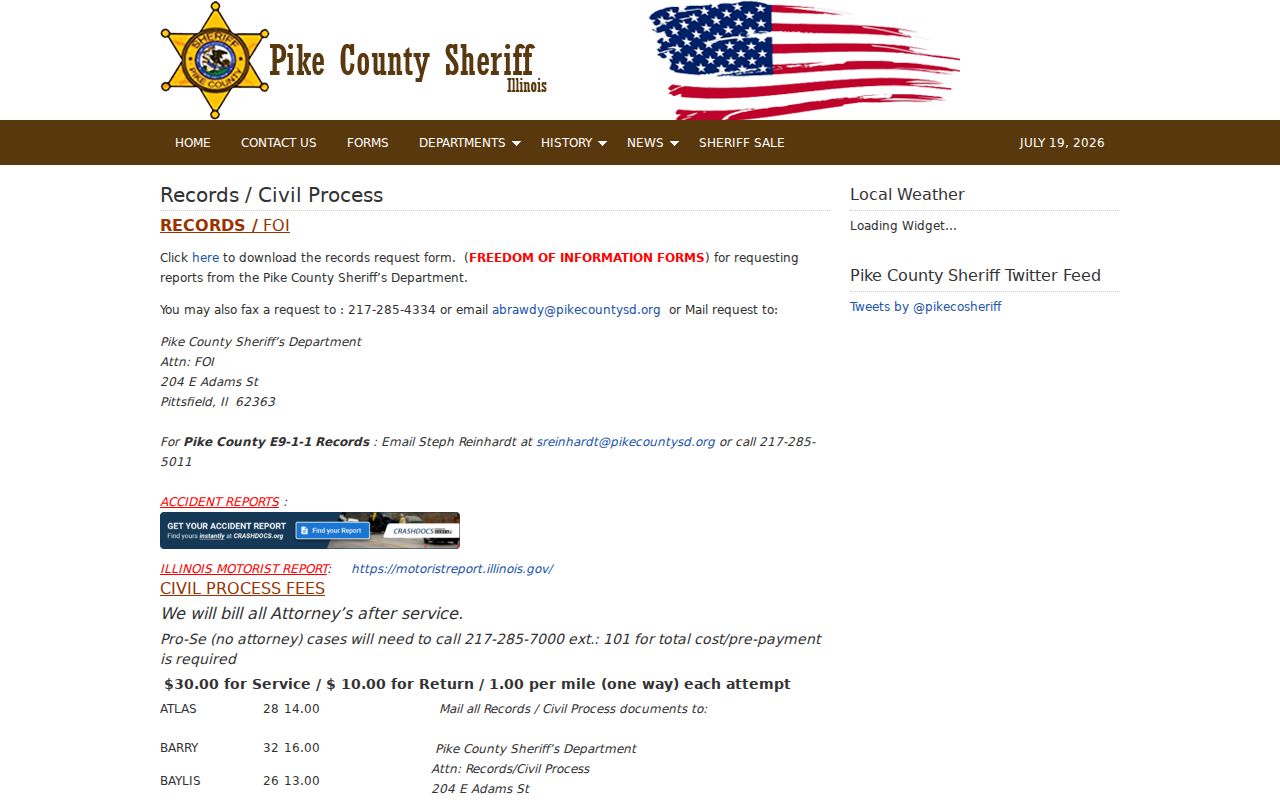
The page is the source for choosing email, fax, mail, or counter service rather than sending a request to the wrong county office.
A useful request identifies the incident date, time, place, report number if known, involved names, precise records sought, and whether inspection or copies are preferred. Illinois FOIA does not make every law-enforcement page public. Active investigations, juvenile material, protected victim data, specialized techniques, and safety-sensitive details can require withholding or redaction.
Inside a Pike County Criminal Record
The visible fields depend on the source. A Judici detail can show the case number, party role, filing date, case type, status, filed counts, event dates, disposition, judge, docket text, and financial balance. A weekly jail entry instead emphasizes identity fields, custody dates, agency, charge text, statute notation, and warrant or hold language. An ISP response uses the identifiers and dispositions reported to the state repository.
| Name & Identifiers | Name, aliases or party role, age or birth information where lawfully displayed, and source-specific identifiers. |
|---|---|
| Arrest / Booking Data | Confined and released dates, arresting or holding agency, and the intake charge description. |
| Charges & Statutes | Filed count text and Illinois citation, which may differ from the booking allegation. |
| Disposition | Dismissal, acquittal, plea, conviction, supervision, or another court outcome. |
| Sentence | Custody, probation, financial terms, or other orders when publicly recorded. |
| Custody / Supervision Status | County jail, IDOC, probation, parole or MSR information must be checked in the system responsible for it. |
From Pike Arrest to Court Docket
An arresting officer's probable-cause charge is the start of a record trail, not the final legal result. If a person enters Pike County Jail, booking staff create a separate intake record and transmit fingerprint-based arrest information for state reporting. The State's Attorney then decides what, if anything, to file. That decision may narrow, change, or omit the arrest allegation.
Once a charge is filed, the Circuit Clerk creates the court case and records hearings, orders, pleas, disposition, and sentence. Justice agencies later report the disposition to ISP. Delays, spelling differences, old paper files, missing fingerprints, or a sealing order can make the systems disagree for a time. The most reliable reading follows the Pike County criminal case to its disposition and treats the booking entry only as evidence of custody and a reported allegation.
Public Access Laws in Illinois
Illinois separates access by record and custodian. The Freedom of Information Act governs requests to local public bodies. The Uniform Conviction Information Act governs ISP's public conviction-information product. The Criminal Identification Act controls repository records and expungement or sealing procedures. Registry disclosure follows its own registration and community-notification laws.
Key Statutes:
5 ILCS 140 - Provides the request framework and exemptions for Illinois public records.
20 ILCS 2635 - Governs public dissemination of Illinois conviction information.
20 ILCS 2630 - Addresses criminal-history records, access, correction, expungement, and sealing.
730 ILCS 150 - Establishes covered registry duties and duration rules.
730 ILCS 152 - Controls sex-offender community notification.
The 1861 Pike Jail Today
Pike County's jail site links local history to current booking records. The original brick jail was built in 1861. An addition opened in 1984, and the facility now has 63 beds. The historic portion serves sheriff administration rather than inmate housing. Current-custody questions go to Corrections at 217-285-5263, option 1, because the weekly report is not a live roster.
The sheriff's jail history documents the building's development and current role.
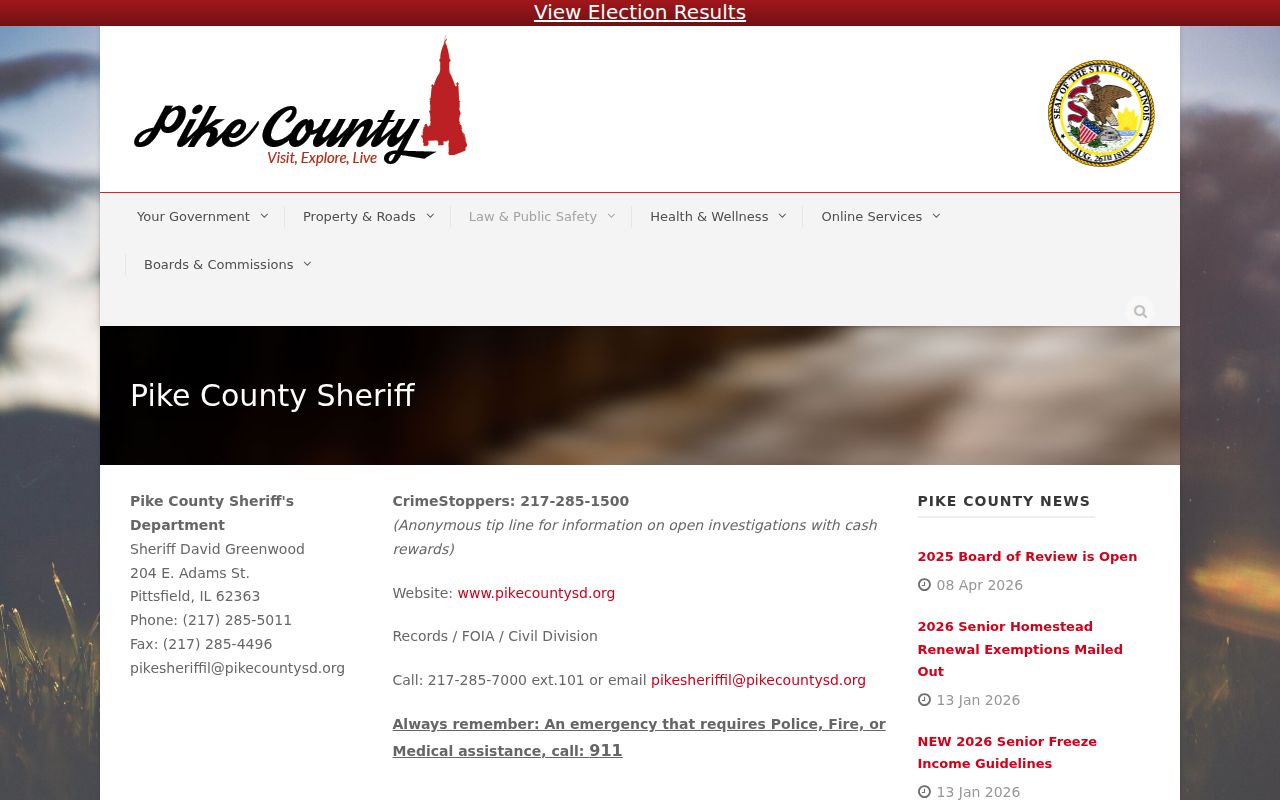
The official sheriff contact page connects the historic Adams Street site with the department that now holds county booking and law-enforcement records.
Sealed, Expunged, and Restricted Records
Illinois expungement and sealing have different effects. Expungement removes, destroys, or returns qualifying records as the statute directs. Sealing keeps the record but restricts ordinary public visibility while preserving authorized access. Acquittals, dismissals, and matters that produced no charge may qualify without a waiting period, while eligible supervision or conviction categories can have different waits and exclusions.
Use the current Illinois Courts packet, list every Pike arrest and case requested for relief, and identify required agencies such as the arresting agency, State's Attorney, Circuit Clerk, and ISP. Police or prosecutors may object, and the court may decide on the papers or after a hearing. A missing public search result can also reflect a sealed case, an older file, or a search mismatch. It does not prove that no record exists.
Pike Probation and Illinois Parole
Probation and parole are not interchangeable Pike County criminal records. Pike County Probation supervises circuit-court sentences from the courthouse and can be reached at 217-285-2041 during its weekday hours of 8 a.m. to 4 p.m. Judici may show that probation was ordered, but officer notes, testing details, and protected supervision information are not a general public database.
IDOC administers parole and mandatory supervised release after state imprisonment, while the Illinois Prisoner Review Board handles release and revocation functions assigned by law. The IDOC Individual in Custody Search can show public custody or release-related status for people in the state system. It cannot answer who is currently held pretrial in Pike County Jail.
The Pike County Probation page provides the local office details.
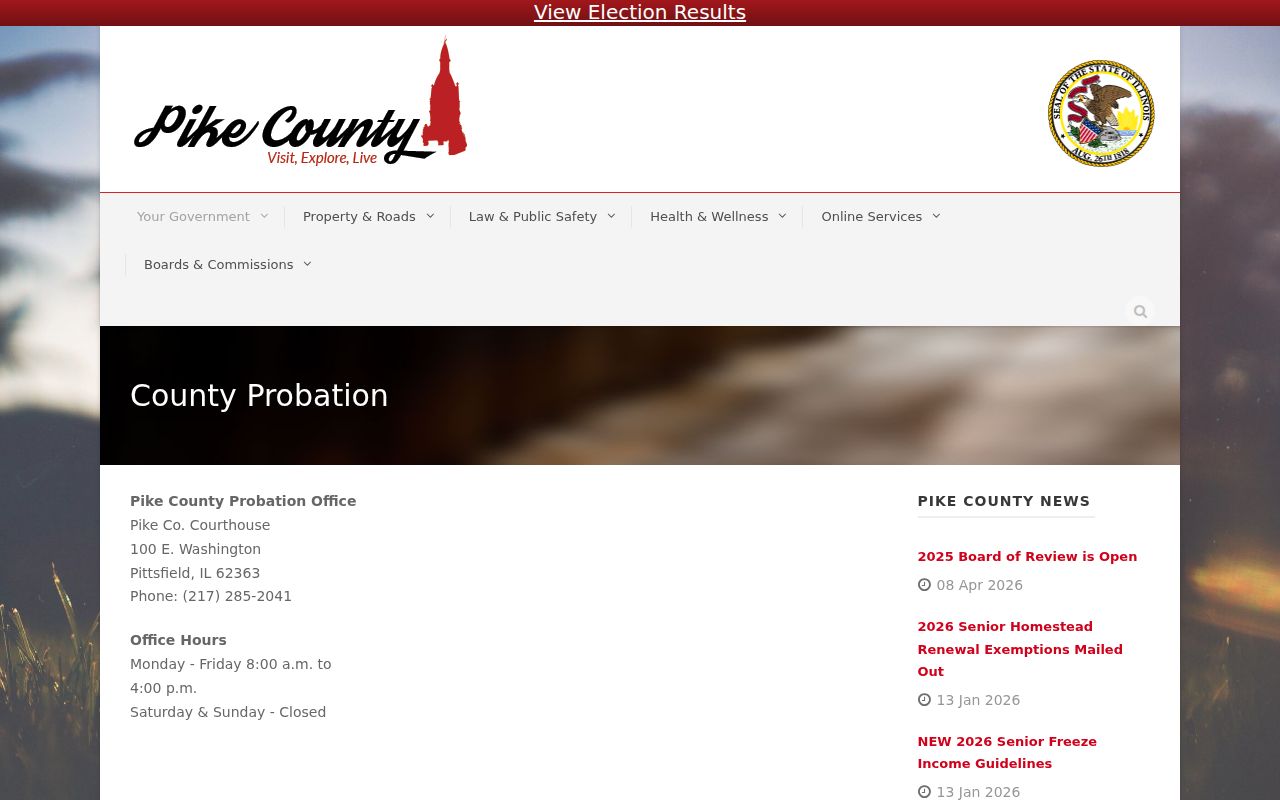
This county source helps separate a Pike probation sentence from IDOC parole or mandatory supervised release.
Pike County Criminal Records by City
Pittsfield, Barry, and Griggsville use different report-request starting points even though their filed criminal and ordinance cases converge at Pike Circuit Court. Pittsfield has a city police FOIA route. Barry contracts with the Pike County Sheriff. Griggsville directs police-record requests through its municipal FOIA officer. County booking records remain with Pike Jail, and Judici supplies the common court index.
Pittsfield Criminal Records
4,206 residents in 2020 · City police reports, county bookings, and Circuit Court cases use three separate channels.
Barry Criminal Records
1,318 residents in 2020 · Contract policing makes Pike Sheriff the local records custodian.
Griggsville Criminal Records
1,104 residents in 2020 · City police FOIA, county custody, and Circuit Court records require separate checks.
Pike Courthouse Records and History
The current courthouse dates to the 1890s and stands on Pittsfield's public square. Its official history describes a red dome, a debate over construction, and a narrow underground route sometimes wrapped in prisoner-transport folklore. The sheriff's account says the passage carried pipes, electricity, heat, and sewer service and was too small for traffic. That distinction is a useful records lesson: a documented source can correct a story repeated without its original context.
The official courthouse history preserves the building account.
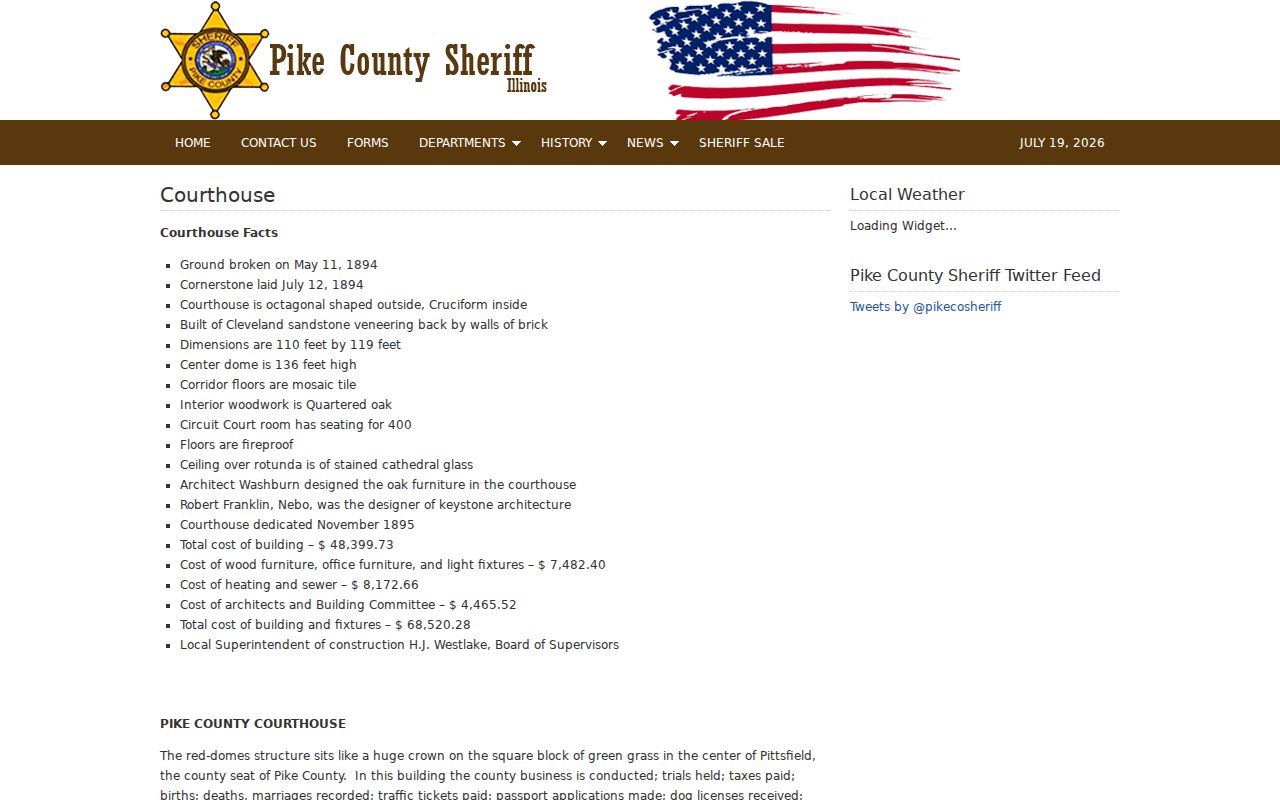
The courthouse remains the central destination for current Circuit Clerk records and for help locating older files that may not appear online.
Pike Charges After an Arrest
The Pike County State's Attorney, not the booking report, determines the counts filed in Circuit Court. The office is at the courthouse and handles criminal prosecution, with separate traffic and juvenile responsibilities identified on its official page. A booking description can therefore differ from the complaint, information, amended count, or final judgment in Judici.
The State's Attorney page identifies the prosecutor's office and links case information.

The source shows the office's place in Pike County's record flow without turning an arrest allegation into a filed or proven charge.
Correcting Your Pike County Record
If your own Illinois history is wrong, compare the questionable entry with the certified Pike County court disposition. Begin with ISP Access and Review rather than guessing from name searches. The fingerprint-based transcript comes with the Record Challenge route, and ISP processing for the review and challenge is free. The capture site may impose its own service fee.
When the issue is a court index, contact the Circuit Clerk with the case number and the specific docket or disposition discrepancy. When the issue is a sheriff report, direct the request to Records/FOI/Civil Process. Keep copies of the challenged entry, certified disposition, and correspondence. These sources have different correction authority, so changing a court docket does not automatically substitute for challenging the state repository record.