
Checking Criminal History in Barry
The first task is to match the question to the custodian. Barry contracts with the Pike County Sheriff's Department for law enforcement. That makes Sheriff Records the right first stop for a Barry incident or arrest report, rather than a police desk at City Hall. A report request and a criminal-history check are not the same product. The report describes a specific event. A weekly jail record shows custody. Judici shows a case after charges reach Pike County Circuit Court. The Illinois State Police Bureau of Identification maintains the state repository.
- Ask Pike County Sheriff Records for the specific Barry report by email, fax, mail, or the sheriff's FOIA form.
- Check the sheriff's weekly LAWMAN arrest reports when the issue involves a recent Pike County Jail booking.
- Search Judici under Pike County for a traffic, ordinance, misdemeanor, or felony case that was filed.
- Contact the Pike County Circuit Clerk when the online index lacks an older file, certified copy, or clear disposition.
- Use Illinois State Police CHIRP for public conviction information or Access and Review for your own full state record.
Barry Records Follow the Sheriff
Barry's official police page states that the city contracts with the Pike County Sheriff's Department. The arrangement controls where a request goes. City Hall can explain city business, but it is not presented as the custodian of a separate Barry police-report archive. The Barry Station is at 1005 Bainbridge Street, Barry, IL 62312. For a record request, current Sheriff Records channels are safer than assuming the station maintains a public counter or its own portal.
The practical test is simple. If a sheriff deputy documented the call, ask Sheriff Records for that report. If jail staff booked the person, use the county jail record. If a prosecutor filed a charge, use the circuit clerk's file. Each record answers a different question, and none alone proves the full Barry criminal history.
Sheriff Records publishes its own request form, but a clear written request can still describe the sought file. Include the Barry address or location, event date, approximate time, involved names, and report number when known. State whether electronic delivery, inspection, or paper copies are preferred. Do not use the CrimeStoppers number to ask for a record or warrant status. The 217-285-1500 line is for anonymous information about open investigations, not record service.
Pike County Sheriff Records
204 East Adams Street, Pittsfield, IL 62363
217-285-7000 ext. 101
Fax: 217-285-4496
Email: records@pikecountysd.org
Barry Police Department Records
There is no separate Barry Police Department records portal in the research. The sheriff's records office accepts requests by email, fax, and mail, and the department publishes a downloadable FOIA form. A useful request identifies the event date, approximate time, Barry location, names involved, and a report number when known. It should also say whether inspection, paper copies, or electronic records are sought. Specific facts help staff locate the right file and reduce back-and-forth.
Law-enforcement material can be redacted. Active-investigation details, confidential sources, specialized techniques, personal information, and facts that could endanger a person may fall within Illinois FOIA exemptions. A partial release does not mean that no fuller agency file exists. A denial should state the legal basis and explain review rights.
A noncommercial FOIA response is ordinarily due within five business days, though the sheriff may invoke a statutory extension. Its current PDF includes older-looking language about an extra seven working days. The sound approach is to preserve the form's wording, track the actual response date, and use the current statute when evaluating timing. No official comprehensive criminal-report copy fee was found, so ask Records for a quote instead of applying the sheriff's unrelated civil-process charges.
Barry's Local Record Starting Point
The City of Barry website gives the local setting for city services, including the resident guide that points people toward contracted law enforcement. It is useful for confirming where city functions begin and where county service takes over.
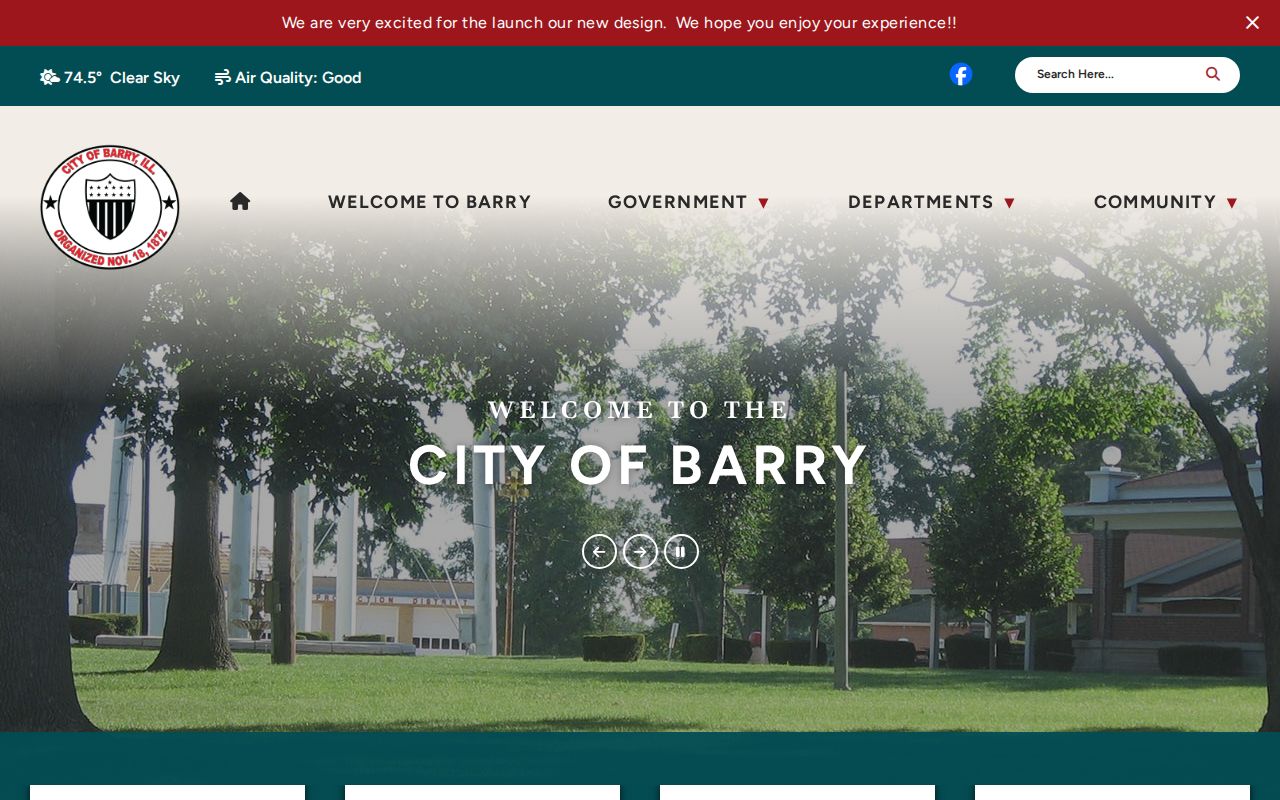
That local distinction matters. Lafayette Park, the Civil War monument, and the annual Barry Apple Festival identify the community, but public-safety records tied to events or places in Barry still follow the agency that created them.
Barry Arrests and Bookings
A person arrested in Barry is booked at Pike County Jail, 204 East Adams Street in Pittsfield. The sheriff publishes weekly LAWMAN arrest reports rather than a permanent Barry arrest database. A weekly report is a dated snapshot. It may show the arresting agency, booking details, and allegations available for that reporting period, but it is not a complete name-based history and does not establish guilt.
Illinois FOIA calls for specified arrest information to be released as soon as practical and ordinarily within 72 hours. That rule covers items such as the person's name, age, address, available photograph, charges, time and place, agency, and custody events. Yet exemptions and timing can affect a particular release. To trace what happened after a Barry booking, move from the jail report to the Pike court docket.
Barry Booking Reports Have Limits
The sheriff's weekly report can confirm a recent county booking, but its week-based design creates traps. No hit may mean the search used the wrong week, the name differs, or the event did not lead to Pike County Jail. It does not certify that a person has no Barry criminal record. It also cannot show whether a prosecutor amended the arrest charge, declined it, or filed a different count.
For current custody, call Pike County Corrections at 217-285-5263, option 1. For a filed outcome, use Judici or ask the Circuit Clerk. When someone receives a state prison sentence and transfers to the Illinois Department of Corrections, the county report stops being the best locator. That later status belongs in IDOC's public custody search.
County jail and state prison data should never be merged without dates. IDOC publicly lists information it may disclose about people in state custody or on parole, while Pike County answers for local detention. A person released from jail may still have an open court case. Another person may have a closed Pike case yet remain in IDOC custody on a sentence. Custody, case status, and criminal history are three different checks.
Municipal Court Records in Barry
No independent Barry municipal-court search was found. Illinois circuit courts exercise trial jurisdiction, and Barry ordinance, traffic, misdemeanor, and felony cases that are filed route through the Circuit Court of the Eighth Judicial Circuit in Pike County. The Pike County Circuit Clerk links to Judici under court code IL075015J. Calling a matter “municipal” does not mean Barry operates a stand-alone docket website.
| Court Name | Circuit Court of the Eighth Judicial Circuit, Pike County |
|---|---|
| Case Types Heard | Filed Barry ordinance, traffic, misdemeanor, and felony matters |
| Case Lookup Channel | Judici Pike County search, then the Circuit Clerk counter or phone |
| What the Docket Shows | Filed charges, events, orders, disposition, sentence, and financial entries when public |
| Copies & Fees | Ask the Circuit Clerk for current copy and certification charges |
When Barry Cases Do Not Appear
A blank Judici result needs context. Recent reports may not yet have become filed cases. Spelling and birth-date variation can hide a match. Sealed or expunged records are restricted, and older Pike files may require clerk or archival help. Some of Pike County's earliest records were lost in an 1829-30 fire, while other historic records were microfilmed or stored away from the courthouse.
Searchers should capture the case number once a likely match appears. Names can repeat, but a case number ties later clerk questions to one file. Review the charge entries, event dates, disposition, and sentence instead of relying on a single line. An arresting officer's initial offense label can differ from the prosecutor's filed count. A dismissed charge and a conviction are not interchangeable, even when both remain visible in the same docket history.
For a modern Barry case, call the Circuit Clerk at 217-285-6612. The office is in the Pike County Courthouse at 100 East Washington Street, Pittsfield, and is open Monday through Friday, 8:30 a.m. to 4:30 p.m. Certified dispositions should come from the clerk, not from a screenshot of a search result. The broader Pike County criminal court case search explains the docket path in depth.
Where Barry Records Go
The sheriff creates the Barry incident or arrest report. Pike County Jail creates a separate booking entry if the person enters custody. The State's Attorney decides what to file, which may differ from the deputy's probable-cause charge. The Circuit Clerk then keeps the court docket, orders, disposition, sentence, and financial ledger. Criminal-justice agencies report eligible fingerprints and dispositions to the state repository.
Record flow: Contracted Pike County Sheriff › Pike County Courts › Illinois State Police Bureau of Identification
A recent event is most likely to appear first in the sheriff's file or weekly booking report. A filed case belongs with the clerk. A state conviction response is a later repository product. Checking these stages guards against treating the first allegation as the final result.
Barry State Record Options
Illinois State Police offers two different paths. CHIRP provides account-controlled UCIA conviction inquiries through an Illinois Digital ID and user agreement. The posted ISP charge is $10 for an electronic name inquiry and $16 for a paper inquiry. A name response is public conviction information, not the subject's complete fingerprint-based history.
The ISP fee schedule shows the official distinction between name and fingerprint inquiries.
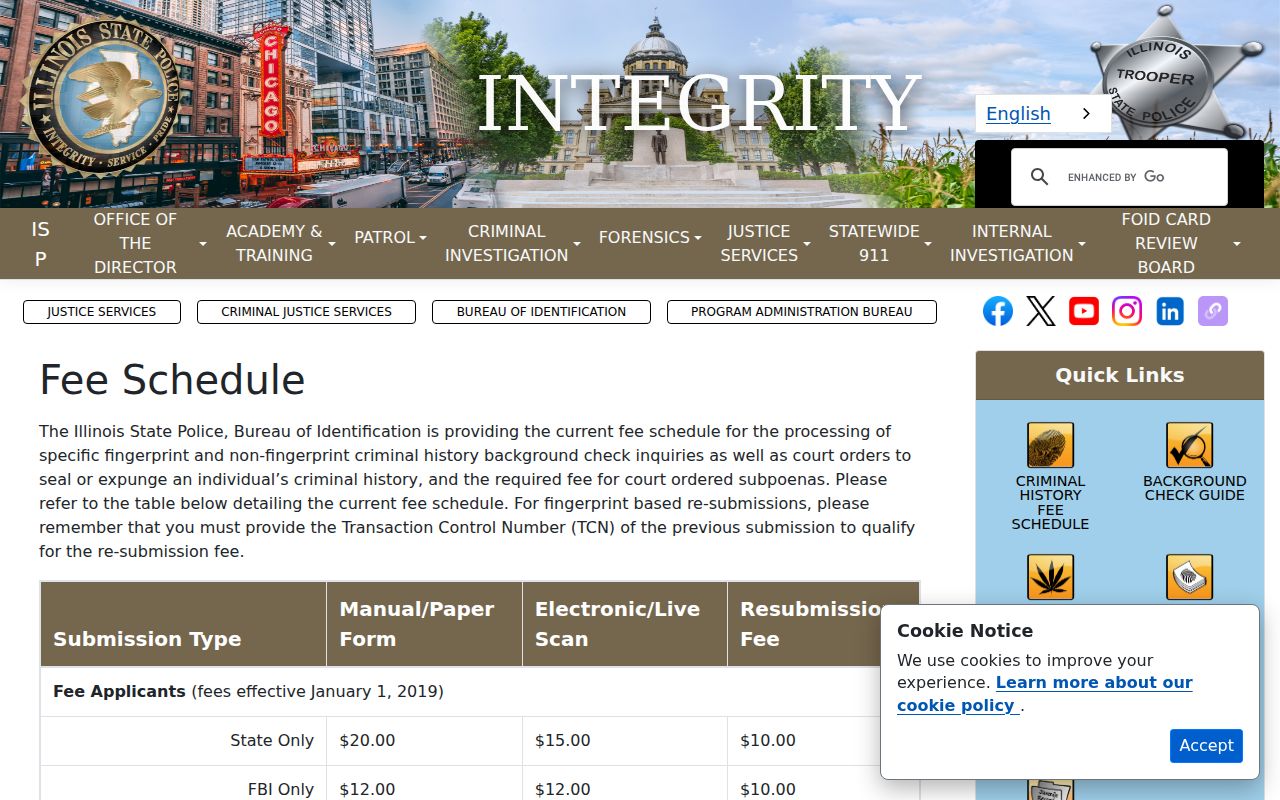
For self-review, ISP's Access and Review process uses fingerprints through an Illinois law-enforcement or correctional facility or a licensed live-scan vendor. ISP processing and a challenge are free, though a fingerprint capturer may charge. The response includes a challenge form when a state entry needs correction.
Barry Policing Is County-Contracted
The city's official law-enforcement notice is the key source for routing a Barry police-record request.
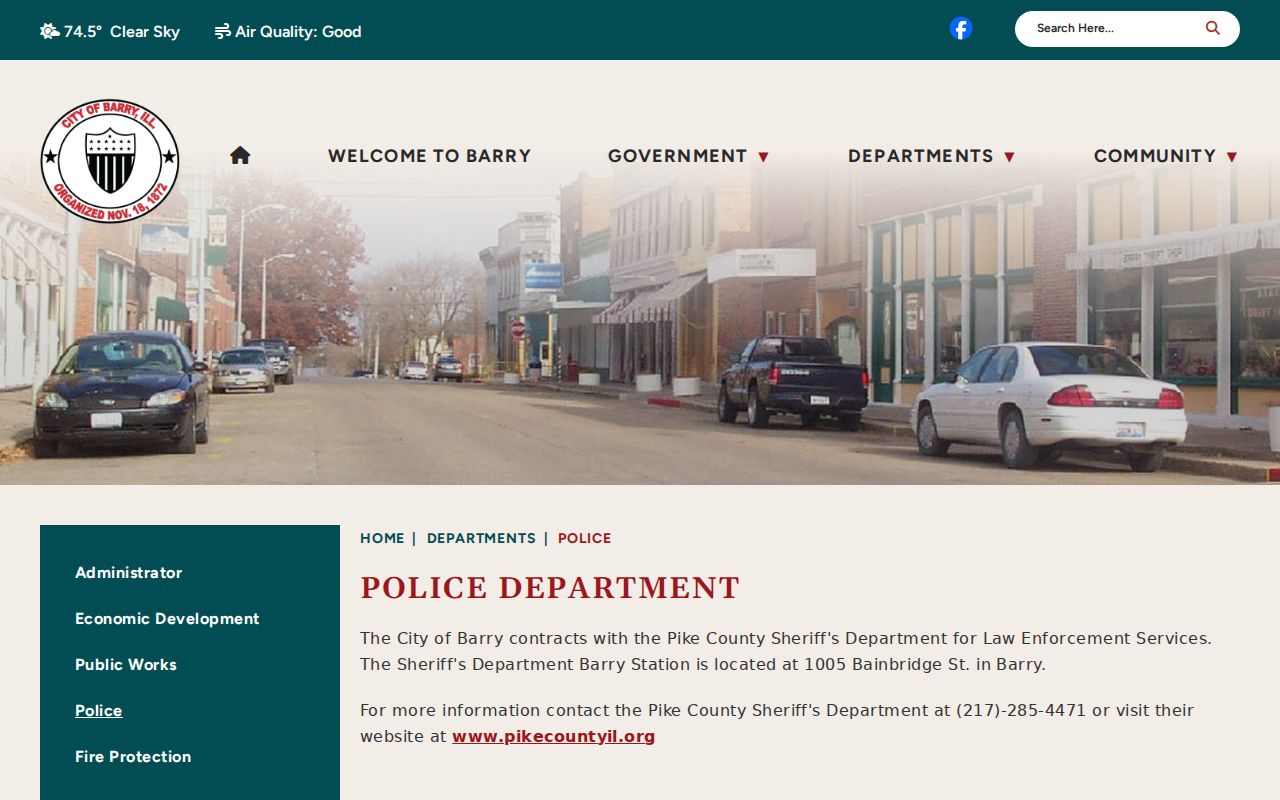
This is more than an administrative detail. It explains why the correct fallback chain runs through Sheriff Records, the weekly county arrest reports, Pike County Jail, and the Circuit Clerk instead of a separate Barry police portal.
Public Access Rules in Barry
The Illinois Freedom of Information Act applies to public records kept by the sheriff and other local bodies. A noncommercial request ordinarily receives compliance or denial within five business days, subject to lawful extensions. The first 50 black-and-white letter or legal pages are generally free, later pages may cost up to 15 cents each, and certification may cost up to $1. Special records and formats can follow other rules.
Key Statutes:
Illinois Freedom of Information Act, 5 ILCS 140 - sets request deadlines, fees, exemptions, and review rights for public records.
Uniform Conviction Information Act, 20 ILCS 2635 - governs public conviction information maintained by Illinois State Police.
Criminal Identification Act, 20 ILCS 2630 - governs state criminal-history records and expungement or sealing procedures.
Public access does not erase context. A Barry arrest allegation, dismissed count, conviction, and supervision status are different facts. Record the source date, check the final court disposition, and use ISP's challenge route when your own repository transcript is wrong.